Building software is a solved problem. What next?
Twenty years ago when I started building tech businesses… no. Wait.
Ten years ago… no, that doesn’t feel right either.
Five. Hmmm…
Four years ago.
No.
Three. OK, three years ago. Just three years ago building software was costly, complicated and reserved for experts or specialists who understood a lot of intricate and complicated concepts, tools, coding languages and paradigms.
Today this is not true.
Today building just about any kind of software is a solved problem.
There’s a guy who just this week released cloned versions of Adobe’s entire suite of products, Photoshop being the one most people know.
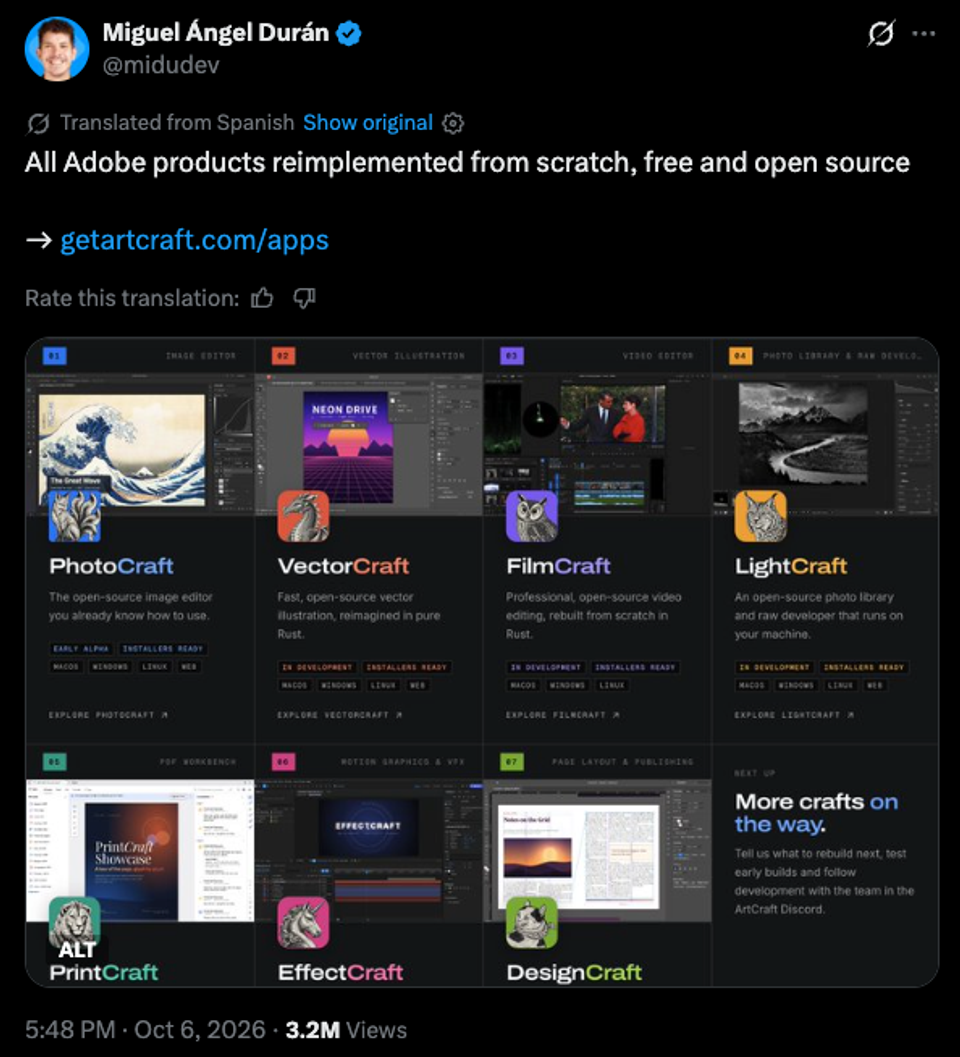
Software is a solved problem. Anyone can build anything. There are website you can visit where you just enter a url and it clones the site for you.
So if software is a solved problem and anyone can build anything what happens next?
Not much for a short time and then who the fuck knows.
Adobe has a market cap of $93bn and one dude cloned it’s entire suite of software. That’s insane.
What that means for the broader world is that software will likely be open-source by default meaning everyone can get the code for anything if they want it.
Now, here’s the thing I tell the solo founders building with me on NoBullShip.co: Building software is not the same as building a business.
Building a business involves a lot more than shipping code.
Building a business involves a lot more than AI-produced copy, design and thinking.
Building a business (for now) means figuring out a whole bunch of things that are not reliant on your ability to ship code.
There’s a lot that goes into building a business that is hidden behind that app icon you tap to get food delivered, book a flight or write a note down. There’s a human being who sat and toiled over the user journey, the design system, the sections you see, the colours they chose, the app structure, the website copy and all the other things that have to happen to make a user not only pay you but well before that, discover you and then trust you and then stay focused enough to pay you and then register and then stick around long enough to generate meaningful revenue (lifetime value in jargon) for the app creator.
And here’s the “what’s next” part that I want to focus on for right now:
What’s next is figuring out what you enjoy doing because if you end up trying to solve a problem that you don’t really enjoy (or love) then you’re going to be beaten by somebody using AI who does love the problem you’re trying to solve half-heartedly.
What’s next is laying a good foundation if you have an idea you want to turn into a business. Thinking has become more relevant when building is basically free. Planning matters now at an individual level not just a broader corporate level.
What’s next is figuring out exactly who you are building and working for? I don’t mean broadly, I mean specifically. I believe that specifics are going to matter a lot in the future because acquiring a huge number of users is going to be difficult and competitive when everyone can build the same thing.
Figuring out your opinion matters in the coming few years. Breaking out of the AI algorithms and feeds that force everyone to extremes or to the boring middle is going to be difficult but important for career survival.
Basecamp is one of my favourite companies in the world and I don’t use any of their products. I love them because they are opinionated even if I don’t agree with their opinion, I respect and admire that DHH and Jason build with such determination and focus on their opinion of how software should be.
What’s next is the emergence of the solo founder as a real economic player in the global economy. Fortune 500 companies will likely hire fewer people who do more in the coming years. Sole entrepreneurship is on the rise and we’re moving into a time when everyone can (and should) have a side business of their own. I run multiple businesses using Grok Bot and various AI tools which act as my operations, finance, marketing and tech employees.
Most importantly in my mind is that everyone needs to look inward and define either own version of success. Do not continue to inherit your ideas of what a successful life or person look like. Success is not a single, measurable, quantifiable and universal idea. It’s personal and needs to be understood as such.
The more closely your idea of success aligns to your ambitions, capabilities, resources and lifestyle choices the easier living is going to be mentally and pragmatically. If you spend your days pining for a better car, a bigger house, a prettier boyfriend, more money or just something someone else has then life in the near future is only going to continue to spiral out of your reach and control. I’m not saying have no or low ambition, I’m saying figure out the trade-offs for the things you want and then move towards your version of success quickly and aggressively.
Building software is a solved problem but it’s only one problem to solve if you’re building a business or a life in the coming years. Don’t obsess over things you can’t control. AI has solved software, now figure out how you can capitalise and get going.